Posts

Showing posts with the label Diode

Schottky diodes

Image
Schottky diodes,metal/semiconductor junction: this heterogeneous junction is characterized  by the absence of storage of charges, it is therefore very fast. It is widely used in circuits fast logic (TTL Schottky). Schottky diode symbol A schottky diode works exactly the same as a diode.The differences are: At the threshold voltage, which is no longer 0.7V, but 0.3V, at 0.4V In terms of speed, schottky diodes are much faster and more expensive Application: Logic circuits: TTL LS technology and derivatives Switching power supply POWER SCHOTTKY DIODES: reduction of the voltage drop in the on state (0.4V at 1A/mm²). no reverse recovery phenomenon (therefore very fast diode)  but appearance of a negative current of the same order of magnitude as the current of the fastest diodes. only limitation: Reverse voltage withstand. it is difficult to exceed 200V Varactor diode This reverse biased diode behaves like a very low value capacitor, the capacity of which...

Photodiode

Image
A photodiode is a semiconductor component that detects radiation from the optical domain and transforms it into an electrical signal. Working principle When a semiconductor is exposed to a luminous flux, the photons are absorbed provided that the energy of the photon E (ph) is greater than the width of the forbidden band Eg.  This corresponds to the necessary energy that the electron must absorb so that it can leave the valence band (where it serves to ensure the cohesion of the structure) towards the conduction band, thus making it mobile and able to generate a Electric power. The existence of the forbidden band implies the existence of an absorption threshold such  that  E(ph)=Eg. During the absorption of a photon, two phenomena can occur: Photoemission: this is the exit of the electron from the photosensitive material. The electron can only exit if it is excited near the surface. Photoconductivity: the electron is released inside the material. The electrons th...

Zener Diode

Image
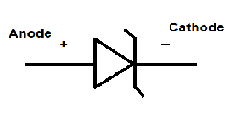
The Zener diode is an electrical component whose properties are similar to a conventional diode , except that the Zener diode lets the reverse current flow when the latter exceeds the threshold of the avalanche breakdown effect. A zener diode makes it possible to produce a constant voltage. Electrical Symbol the symbol is similar to a diode, unlike the side of the cathode which looks like an inverted Z. The side of the anode is the same as the symbol for a diode. Zener diode symbol Operation characteristic: Zener diode characterstic In direct assembly the zener diode conducts but there is "a threshold voltage" as for the diode. In direct Vak <1volt. Conversely, the current is practically zero (I <1µA) if Vak> Vz, we say that the diode is  blocked. If Vak <Vz, there is a "zener effect", ie the Vak voltage varies very little. in zener the power lost in the component increases when the current modulus increases. The manufacturer specifies the maximum ...

Diode

Image
  Diode is a non-linear, polarized electronic component. The direction of connection of the diode therefore has an importance on the operation of the electronic circuit.  It is a dipole that only allows electric current to flow in one direction. This dipole is called a rectifier diode when it is used to make rectifiers that transform alternating current into unidirectional current. Diode Symbol In the category of diodes, there are also regulation diodes, called zener diodes, which behave as a voltage source. This property will make it possible to develop around this simple component a whole series of assemblies delivering one or more direct voltages. Operation The diode is a switching component which has 2 operating modes: • Diode in the state: On. • Diode in the state: Blocked. The diode can switch from on to off state. Current-voltage characteristic of the diode: Above a certain positive voltage Vd threshold Vo, the forward current increases very rapidly with Vd...