Posts

Diode

Image
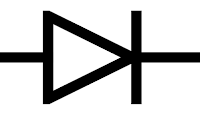
  Diode is a non-linear, polarized electronic component. The direction of connection of the diode therefore has an importance on the operation of the electronic circuit.  It is a dipole that only allows electric current to flow in one direction. This dipole is called a rectifier diode when it is used to make rectifiers that transform alternating current into unidirectional current. Diode Symbol In the category of diodes, there are also regulation diodes, called zener diodes, which behave as a voltage source. This property will make it possible to develop around this simple component a whole series of assemblies delivering one or more direct voltages. Operation The diode is a switching component which has 2 operating modes: • Diode in the state: On. • Diode in the state: Blocked. The diode can switch from on to off state. Current-voltage characteristic of the diode: Above a certain positive voltage Vd threshold Vo, the forward current increases very rapidly with Vd...

Buffer

Image
It should be noted that the operational amplifier is an active component and that it has a low output impedance. Namely that he will be able to behave like a source of tension.  This is useful when you apply a voltage with low load carrying capacity as input. We will speak of a "buffer" stage. it is designed to allow impedance matching between two successive stages of a circuit. Of course, this does not go without modification of the input signal: it is therefore necessary to be careful with the offset introduced by the AOP, the distortion that it will insert on the input signal, its band gain product and thus its be able to correctly pass high frequency signals,Note that the input and output are not reversed. Linear applications 1) Voltage follower amplifier Follower op amp b) formula Vout = Vin c) Remarks The resistance at the input of the assembly is infinite. The voltage follower makes it possible to take a voltage without disturbing it, because it has...

Variable Resistor

Image
A variable resistor is a resistor whose value is variable.many factors can induce a variation of R according to its constitution. The most common are the following factors: Mechanical: Most often a variation in the length of the resistant body. These are strain gauges, Potentiometers or Rheostats. Thermal: The temperature to which the resistance is subjected (thermistor). We can find the Positive Temperature Coefficient resistance (the resistance increases when the Temperature increases) and the Negative Temperature Coefficient (the resistance decreases for an increase in T). Radiation: The radiation to which the resistance is subjected. (Many models exist, each one is sensitive to a specific radiation range). Chemical: A substance (gas, liquid, solid) brought into contact with the resistance. Electrical: the varistor is a resistor whose value drops from a threshold voltage. NTC Thermistors  Thermistors or resistors with negative temperature coefficient or N...

Instrumentation amplifier

Image
  Definition An instrumentation amplifier is an electronic device for processing weak electrical signals. The typical application is the processing of signals from measurement sensors. Its operation is based on the principle of differential amplification. The instrumentation amplifier is generally made from one or more operational amplifiers, in such a way that it improves their intrinsic characteristics: offset, drift, amplification noise, open loop gain,  common mode  rejection ratio (CMRR), input impedance. fig 1 :instrumentation amplifier The first stage: we will use the fact that the inputs v + and v- of the amplifiers are equal, and that the input impedances are infinite. the current flowing in Rg and in the two resistors R is the same, so We can write: V1 − V2 = Rg× i Vod = (2R+Rg) x i Vod = (V1-V2) x ((2R+Rg) /Rg) The common mode voltage at the input of the assembly is: (Vcm)input = (V1+V2) / 2 the common output mode is equal to: (Vcm)output= (Vo...

NTC thermistors

Image
The thermistor is an element that detects temperature. It is made of a semiconductor material that captures all temperature changes. They have negative temperature coefficients. In this case, the resistance of the thermistor decreases when the temperature increases, this one is then also called NTC thermistor. When the Joule effect (heating due to the passage of current) is negligible, we can express a relation between the resistance of the NTC and its temperature by the following relation: The temperatures are  in degrees Kelvin, B and T0 are constants of the component.. NTCs are made from oxides of transition metals (manganese, cobalt, copper and nickel). These oxides are semiconductors. Characteristics: NTCs can be used in a wide temperature range, from -200 ° C to + 1000 ° C, and they are available in different versions: glass beads, discs, bars, pellets, washers, chips etc.  The nominal resistances range from a few ohms to a hundred kohms. The response time depends ...

Phototransistor

Image
A photo-transistor is an electronic component capable of reacting to light by letting current flow. Like transistors, the photo-transistor is designed according to a base, emitter, a collector. But the base is sensitive to light and therefore controls the flow of current through the collector. The photo-transistor is much more sensitive than a photo-diode. A classic photo-transistor-based assembly is the Darlington: a photo-transistor controls a classic transistor, which is very efficient for light barriers or obstacle detection. Phototransistor  Symbol The phototransistor is manufactured most of the time in silicone, but also in other materials (ceramic, and others). The phototransistors are enclosed (generally) in a small opaque or transparent shell, in order to strengthen the light that passes through it and allows light to reach sensitive areas of the phototransistors. How a phototransistor works ? A phototransistor is a transistor whose base B is controlled by the lighti...

Capacitor

Image
a capacitor is a component made up of 2 parallel conductors, called plates separated over the entire extent of their surface by a thin insulator, expressed by its dielectric strength ε r (epsilon) or relative permittivity. The capacitor is an electronic component which has the particularity of being able to store energy when it is subjected to a voltage. This component is essential in the field of electricity, it is almost as common as resistance. Capacitor Symbol Charg e and energy stored in a capacitor The charge that can be stored in a capacitor of capacitance C in farad is given by the formula: Q =  C x  U The constants of this equation are : C: capacitor capacity in Farads (F) Q: capacitor charge in Coulombs (C) U: voltage across the capacitor in Volts (V) Definition of farad: capacitance of a capacitor containing 1 coulomb under 1 volt. The energy stored in joules can be calculated with:  Electrical model of real capacitors the manufacturing method and...